
Bringing all aspects of our single-source tension fabric structures in-house has been part of Legacy’s evolution these past 10 years. That’s what single-source means to us, and it’s why our customers rely on us for tension fabric buildings and fabric storage solutions that perform over the long term.
We began with the fabric plant, welding our own fabric panels for walls, roofs, end walls and liners. Then we started fabricating our own steel beams for the frames. Finally, in 2019 we built our paint shop, where we apply our proprietary epoxy coatings to the steel used in our fabric-covered buildings. This complete control over design, manufacturing, coating and installation is what defines our single-source tension fabric structures.
Single-Source vs. Self-Installation
Because we manage the entire process, we can offer multiple installation options. Many customers choose professional installation using our trained crews or approved partners, ensuring that the frame alignment, fabric tensioning, anchoring and finishing details are all completed to engineered specifications. Other customers opt for a more hands-on approach, using their own construction teams while relying on our engineering, detailed drawings and technical support to guide a self-installation.
Both options can be successful, but professional installation typically shortens the schedule, reduces rework and helps guarantee that the building performs exactly as designed. Self-installation can lower upfront labor costs, but it requires careful adherence to our installation guidelines and close coordination with our engineering team to maintain structural integrity and long-term performance.
How Installation Affects Durability & Performance
The installation process has a direct impact on the durability and performance of fabric buildings. Properly tensioned fabric, correctly placed anchors, accurate frame plumb and alignment, and precise foundation work all contribute to how the structure handles wind, snow, corrosion and daily use. Poor soils, site slopes or harsh weather can introduce challenges, which is why our engineering and field teams work closely together to adjust foundations and anchoring methods as needed.
By controlling design, engineering, fabrication, coatings and installation logistics, we minimize variables that could compromise performance. Our in-house epoxy coating line protects the steel frames, while our installation standards ensure that every anchor and connection is installed to meet or exceed code requirements. This holistic approach helps extend the life of the building and maintain its structural performance.
What Are Single-Source Tension Fabric Structures?
Single-source tension fabric structures are buildings in which one provider is responsible for the complete project lifecycle: concept, design, engineering, steel fabrication, fabric production, protective coatings, logistics and installation support. Instead of coordinating multiple vendors for each component, owners work with a single team that understands how every part of the structure interacts.
This approach reduces handoffs, miscommunication and scheduling conflicts. It also allows us to customize each building to the site conditions, local codes, environmental loads and operational requirements, whether the project is for fabric storage solutions, industrial applications or other custom fabric-covered buildings.
Case Study: Tight Deadlines & Complex Conditions
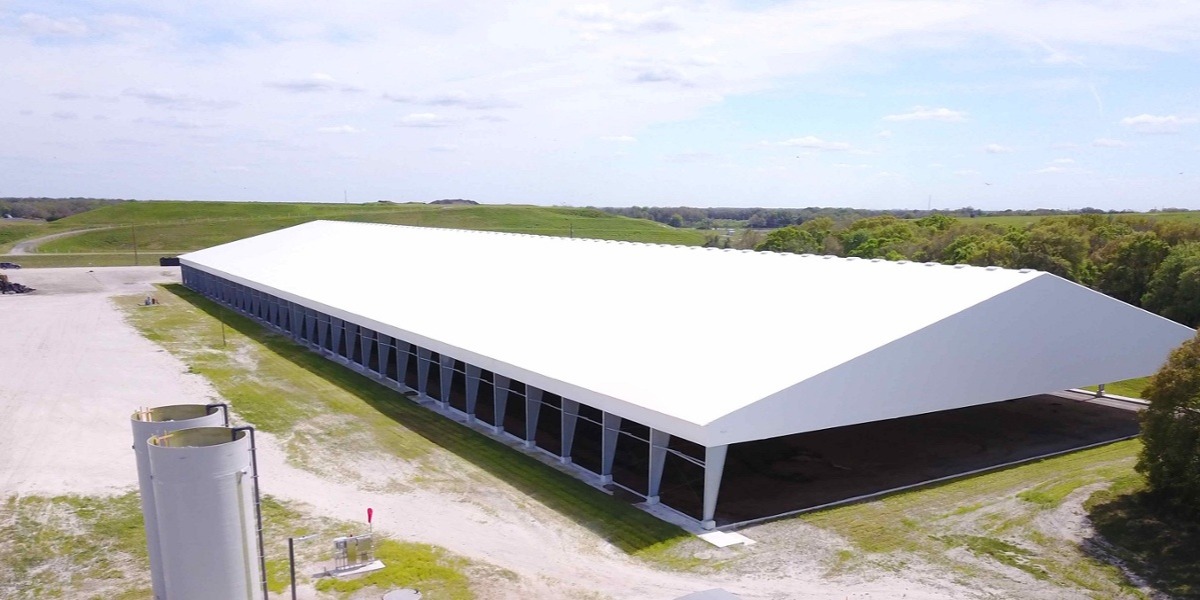
In a few cases, the ability to turn around a project quickly has made all the difference. Completing a biosolids composting structure in Southeast County, FL was a direct result of Legacy owning all the logistical pieces for our single-source tension fabric structures. We knew what we were capable of and we knew we could meet the challenge of a tight deadline with this large example of our tension fabric buildings.
This structure was a very large covered building open to the air, using a new composting process that turned biosolids into usable compost very quickly. The process was proprietary and had only been used once before in a pilot project, so choosing fabric-covered buildings that could be customized was critical.
For this project, we partnered with TLC Diversified, a water treatment and management contractor, to get this building installed. Original plans suggested the project be split into two buildings, but because of our use of solid steel rigid I-beam frames, we could make the entire project into one building of 139,750 square feet—about 3 acres completely covered by our structure.
This composting facility had to be done, start to finish, in six months. That was the requirement from the county. Our combined teams collectively analyzed the necessary actions that needed to occur, and with communication and support from all parties involved, we decided we could make that timeline using our proven fabric-covered buildings approach.
Beating Our Best Estimates
We came back to TLC and said not only could we meet that timeline, we might be able to do better than that. John Elder, a project manager for TLC, said: “The thing that impressed everybody was the fact that Legacy came through and said, ‘hey we are going to better our time as far as manufacturing and shipping.’ And if I remember right, it was at least by a month.”
Installation began at the beginning of August 2019. Other challenges the team faced were poor soils, more slope than anticipated, and a very rainy “rainy season.” Nevertheless, the foundation was right on target, all 650 feet of it. Every anchor for the structure was precisely placed, ensuring the long-term performance of the tension fabric buildings on site.
Dalas Lamberson, vice president of TLC, said that a lot of the success of this team effort was due to communication. The urgency of the project had everyone answering their phone right away. “We all had our problems, but we found solutions quickly,” he told us. “It was exciting to build it in six months.”
Benefits of Tension Fabric Structures
Many of our own values and efficiencies have pushed us in the direction of being a single-source provider of tension fabric structures. By eliminating obstacles, or potential obstacles, we have discovered that we can meet our deadlines and deliver for our customers. The benefits to owners include faster project delivery, consistent quality, customized design, reduced maintenance and a building that is engineered to perform for decades.
That means delivering on our promises, and that is something we are proud of each time we finish a project—whether it’s for fabric storage solutions, industrial tension fabric buildings, or other custom fabric-covered buildings.
