
Why Clubs Are Choosing PVC-Clad Solutions for Indoor Tennis Facilities
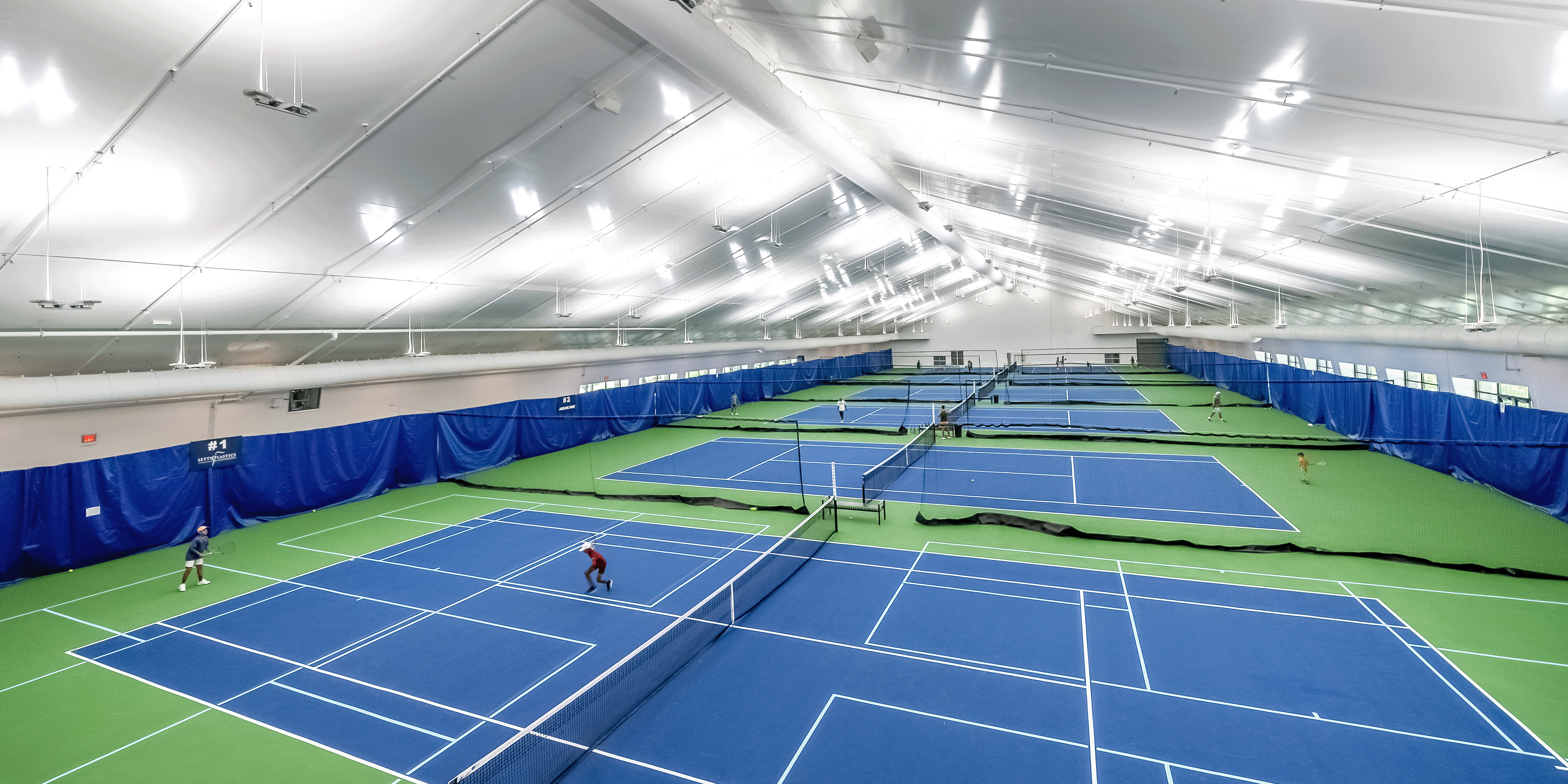
If you’re planning an indoor tennis facility, performance matters just as much as protection from the weather. Today’s racquet sports facilities must deliver year-round playability, meet governing standards, operate efficiently and create an environment players genuinely enjoy.
That’s why more owners and developers are moving beyond traditional brick-and-mortar construction and exploring PVC Clad structures. Modern rigid-frame PVC Clad building solutions provide the strength of steel with faster construction timelines, improved energy efficiency and full compliance with USTA standards.
Facilities like Ellington Racquet Club in Connecticut and The Courts of McKinney in Texas demonstrate how Legacy Building Solutions is redefining what USTA-compliant tennis buildings can achieve.
Engineered for USTA-Compliant Tennis Buildings
Designing a USTA-compliant indoor tennis facility requires more than simply enclosing courts. Indoor play standards call for a minimum 18-foot eave height, 38-foot ridge height, proper spacing between courts and consistent lighting levels of 70–100 footcandles.
Legacy’s PVC Clad building solution is engineered to meet these requirements while also complying with IBC regulations for wind, snow and seismic loads. Unlike air-supported domes, rigid steel frames provide a stable, permanent structure that does not shift or require seasonal inflation.
The structural system is also designed to carry LED lighting systems, fire suppression and sprinkler systems, divider nets, scoreboards and suspended equipment. This integrated engineering ensures that your indoor tennis facility isn’t just code compliant—it’s built for long-term durability, performance and tournament-level play.
Ellington Racquet Club: Award-Winning Indoor Tennis Facility
When Tracy French set out to develop Ellington Racquet Club, her goal was to create more than courts—she wanted a year-round indoor tennis facility that would foster community and support both tennis and pickleball.
“You have to think through every little step—things you don’t always consider at the start. The small details, they all matter.”
After exploring traditional steel construction, she selected Legacy’s PVC Clad building solution for its flexibility, speed and structural integrity.
“Shannon always got back to me—if he didn’t know the answer, he found it. That made a huge difference.”
The 44,880-square-foot fully insulated indoor tennis facility opened on schedule in October 2024 and quickly became a hub for leagues and daily play. The facility received the “Outstanding Building of the Year” award from USTA, further validating its design and performance standards.
“The only challenge we ran into was HVAC—the system was over-engineered because the contractors didn’t anticipate just how energy efficient the building would be.”
The Courts of McKinney: A Fully USTA-Compliant Tennis Building
In McKinney, Texas, The Courts of McKinney Tennis Center required a facility that would meet USTA standards while supporting a growing community of players.
“When I journeyed to Minnesota to visit Legacy’s headquarters, I witnessed firsthand that they could provide us with everything, if not more, than a standard brick-and-mortar building. The swiftness and cost-effectiveness of their approach was truly remarkable.”
The 47,125-square-foot indoor tennis facility houses six courts within a fully insulated structure engineered to meet USTA regulations and local building codes. The rigid steel frame supports climate control systems, divider curtains and fire suppression infrastructure.
Why PVC Clad Structures Are Redefining Indoor Tennis Facilities
Modern PVC Clad structures offer advantages that traditional indoor tennis facilities often struggle to match, including year-round performance with insulation up to R-30, faster construction timelines, improved energy efficiency and structural strength that meets IBC standards.
Building the Future of USTA-Compliant Indoor Tennis Facilities
Ellington Racquet Club’s USTA “Outstanding Building of the Year” recognition demonstrates the impact a thoughtfully engineered indoor tennis facility can have. The Courts of McKinney reinforces that fully USTA-compliant tennis buildings can be delivered faster and more efficiently with a PVC Clad building solution.
Legacy delivers rigid steel structural integrity, full insulation for year-round comfort, USTA-compliant court dimensions and integrated building systems—creating indoor tennis facilities where athletes and communities thrive.
Frequently Asked Questions
A PVC Clad building solution uses a rigid steel frame with a PVC Clad exterior system and insulated interior package to create a durable indoor tennis facility designed for year-round play.
Yes. Properly engineered PVC Clad structures can meet USTA indoor play recommendations for clearance heights, court spacing and lighting while also complying with local building codes.
With insulation options up to R-30 and integrated climate-control planning, PVC Clad indoor tennis facilities can operate comfortably in cold, hot and mixed climates.
PVC Clad structures are typically installed faster than conventional construction methods, helping owners open sooner and generate revenue earlier.
Yes. Rigid steel frames can support lighting, fire suppression, divider nets and scoreboards, and facilities can incorporate spectator seating, pro shops, locker rooms and viewing areas.